
What Is Urolithin A?
Urolithin A is a small molecule produced when certain intestinal bacteria metabolise ellagic acid and ellagitannins — plant compounds present in foods including pomegranates, walnuts, pecans and some berries.[3]
It is often called a gut-microbiome-derived metabolite. It is also sometimes described as a postbiotic, although definitions of “postbiotic” vary and the term should not be used to imply a proven health benefit.
Urolithin A in 30 seconds
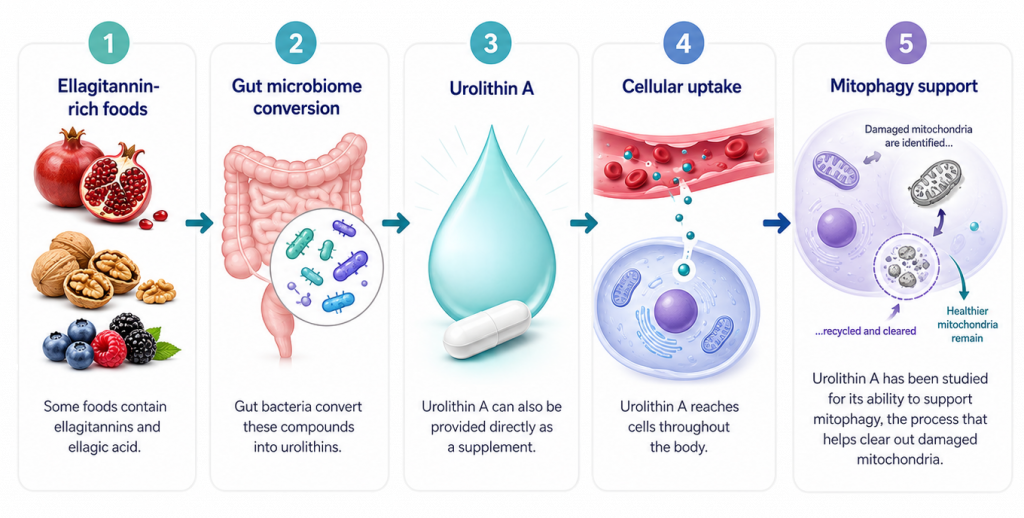
Urolithin A belongs to a family of compounds called urolithins. Your body does not normally obtain a large, predictable dose of Urolithin A directly from fruit. Instead, bacteria in the large intestine may transform ellagitannins and ellagic acid from food into several urolithins, including Urolithin A.[3]
People vary considerably in their ability to make it. In one study of 100 healthy adults, only 12% had detectable circulating Urolithin A at baseline. After a standard serving of pomegranate juice, about 40% became substantial producers over the following day, while the remainder produced little or none under the study conditions.[3] This does not mean that exactly 40% of every population can produce it; it illustrates how strongly individual microbiomes can affect exposure.
From food to Urolithin A
The simplified pathway is:
Ellagitannin-containing food → ellagic acid and related compounds → bacterial metabolism in the large intestine → urolithins → absorption and metabolism
Ellagitannins can release ellagic acid during digestion. Specific gut microbes then perform a series of chemical transformations that remove hydroxyl groups and produce different urolithins. Urolithin A is one of the most studied products of this pathway.[3]
After absorption, much of the circulating material is present as conjugated metabolites such as Urolithin A glucuronide and Urolithin A sulfate rather than only as unconjugated Urolithin A.[3]
Which foods contain Urolithin A precursors?
Foods reported to contain ellagitannins or ellagic acid include:
- pomegranates, particularly the peel, pith and juice-derived compounds;
- walnuts and pecans;
- raspberries, strawberries and blackberries;
- some other fruits and nuts, with content varying by variety, ripeness, processing and storage.
These foods can be valuable parts of a varied diet for many reasons. They should not be promoted as a precise “dose” of Urolithin A. The amount of precursor differs between foods, and the amount of Urolithin A ultimately produced depends on the person’s microbiome and metabolism.
Is Urolithin A actually present in pomegranate?
A more accurate statement is that pomegranate contains precursors from which gut bacteria may produce Urolithin A. A bottle labelled “pomegranate extract” is therefore not automatically equivalent to a product containing a measured amount of Urolithin A.
When comparing research or products, ask whether the intervention contained:
- pomegranate juice;
- pomegranate extract;
- ellagic acid;
- ellagitannins;
- purified Urolithin A;
- or a mixture of ingredients.
The evidence for one cannot automatically be transferred to another.
Why do some people produce more than others?
The required metabolic steps depend on particular bacteria and bacterial enzymes. Microbiomes differ between people and can change with age, diet, medicines, illness and many other factors.
In a controlled study of 100 healthy adults, only 12% had detectable circulating Urolithin A at baseline. Twenty-four hours after pomegranate juice, around 40% were classified as substantial converters; about 60% remained non-producers or poor producers under the study conditions.[3]
This finding should not be converted into a universal claim that “only 40% of people can make Urolithin A.” It came from one population, one dietary challenge, one time window and a defined laboratory threshold.
What are urolithin metabotypes?
Researchers use the term urolithin metabotype to group people according to the pattern of urolithins produced after consuming ellagitannin-rich foods. Different metabotypes may produce Urolithin A, Urolithin B or related intermediates in different proportions.
Metabotypes are research classifications, not routine medical diagnoses. Commercial microbiome tests should not be assumed to give a clinically validated prediction of who will benefit from Urolithin A.
Is Urolithin A a vitamin or essential nutrient?
No. Urolithin A is not recognised as a vitamin, mineral or essential nutrient, and there is no established Urolithin A deficiency disease or dietary reference intake.
Calling it “essential for mitochondria” would therefore be misleading.
Is Urolithin A natural?
The molecule can be produced naturally by gut bacteria. Urolithin A used in research products, supplements or cosmetics may be manufactured and purified to a defined specification. The FDA GRAS notice considered a chemically synthesised ingredient.[12]
“Natural” and “synthetic” do not by themselves determine safety, quality or effectiveness. Relevant questions include identity, purity, contaminants, manufacturing controls, stability, dose and evidence for the finished product.
Is Urolithin A an antioxidant?
Urolithins have shown antioxidant and anti-inflammatory activity in experimental systems, but describing an oral product simply as an “antioxidant supplement” can overstate what has been established in people. The most prominent research focus for Urolithin A has been mitochondrial quality control and mitophagy, with additional investigation of inflammation and metabolism.[1,2,6]
Key takeaway
Urolithin A is best understood as a microbiome-derived molecule under active study. Foods provide precursors, not a guaranteed amount of Urolithin A. Direct supplementation provides a more predictable exposure in research settings, but predictable exposure does not guarantee a meaningful health benefit.[3]