
Urolithin A in Skincare
Urolithin A is appearing in topical products because mitochondrial quality control and cellular ageing are relevant to skin biology. That scientific rationale is interesting, but the cosmetic evidence is much less mature than the marketing language often suggests.
Why might a cosmetic company use it?
Skin contains cells with mitochondria, and ageing skin shows changes in cellular metabolism, extracellular matrix, pigmentation, barrier function and responses to environmental stress. Researchers have investigated whether Urolithin A affects pathways related to:
- mitochondrial function and mitophagy;
- cellular senescence;
- collagen and extracellular-matrix biology;
- oxidative and ultraviolet stress;
- visible skin texture and wrinkles.
This list describes research targets, not guaranteed product effects.
What evidence is available?
A 2023 medRxiv preprint reported mechanistic experiments and topical clinical studies using formulations with 0.5% or 1% Urolithin A. The authors reported changes in measures associated with intrinsic skin ageing and UVB-induced redness.[10]
A preprint has not completed the standard peer-review process. Results can be revised, and the methods and analysis require careful independent evaluation.
Products containing Urolithin A
Lancôme Absolue Longevity MD
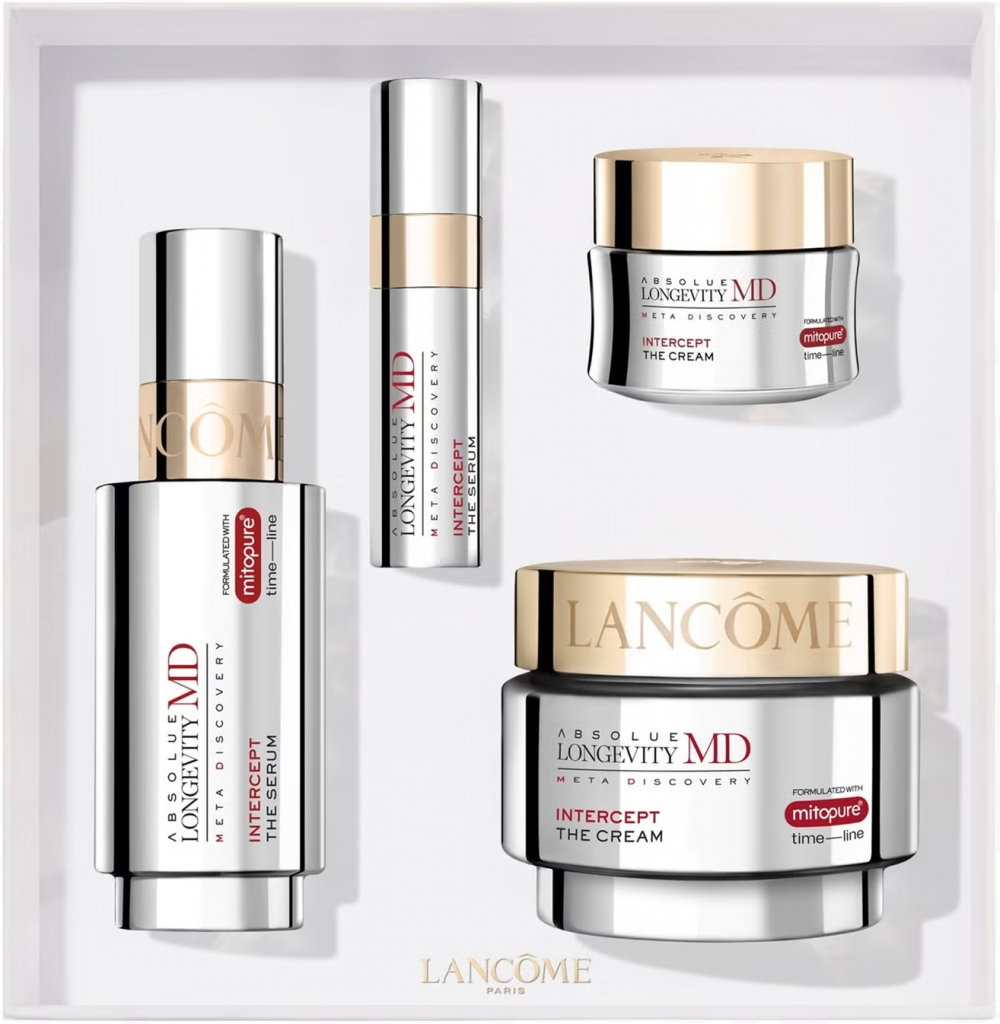
One of the most prominent commercial uses of Urolithin A in skincare is Lancôme’s Absolue Longevity MD collection.
The range contains a highly purified form of Urolithin A. Lancôme combines it with different cosmetic ingredient complexes across three ranges:
Anticipate — aimed at visible skin ageing before signs become established
Intercept — aimed at visible ageing signs as they appear
Reset — aimed at more established visible signs of ageing
The collection currently includes Anticipate The Cream, Intercept The Serum, Intercept The Cream, Reset The Serum and Reset The Cream.
For prevention / earliest signs of ageing…
A premium face and eye cream containing a purified and micronised form of Urolithin A, combined with Lancôme’s Anticipate Compound™.
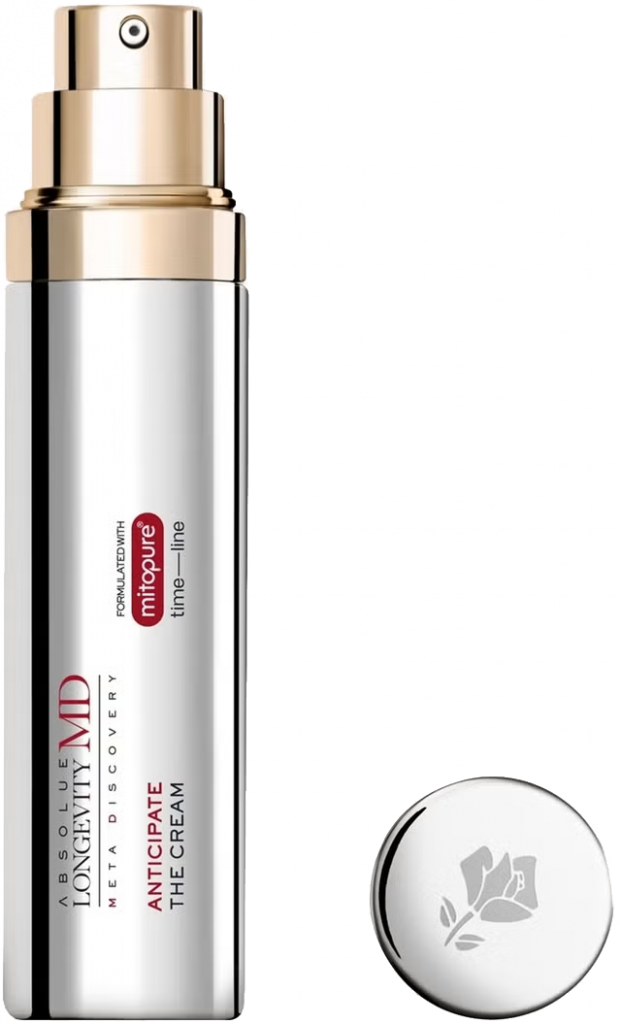
Lancôme positions Anticipate as the preventative stage of its Longevity MD range, designed to target visible signs of skin ageing before they become established.
What Lancôme reports
- Up to 16% fewer incoming fine lines after three months
- Protection against skin-surface oxidation in an ex-vivo test
- Improvements in radiance, skin roughness and pore visibility
The fine-line result comes from clinical scoring of 76 people after three months.
Key ingredients
Urolithin A + Anticipate CompoundTM, containing ingredients including ectoin, eperuline, Rose Pro-Xylane™ and taurine.
UrolithinA.com view
An interesting example of Urolithin A being incorporated into preventative premium skincare. The reported results relate to the complete Lancôme formulation, however, and should not be interpreted as evidence that Urolithin A alone produces these effects.
For emerging visible signs of ageing…
The cream counterpart to Intercept The Serum, combining Urolithin A with Lancôme’s Intercept Compound™.
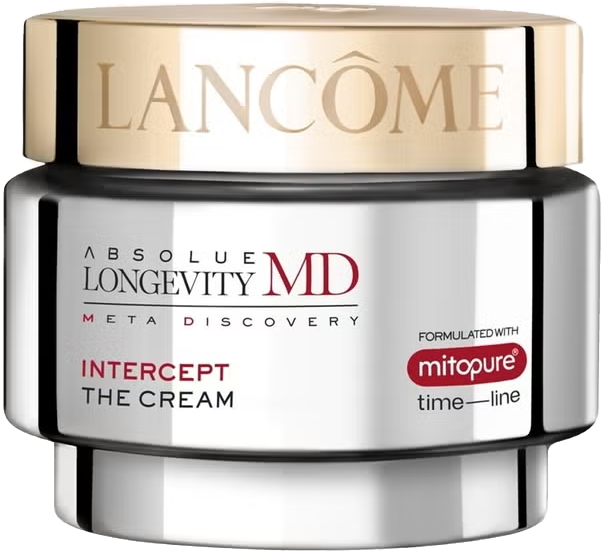
Lancôme describes it as targeting visible ageing signs as they begin to appear.
What Lancôme reports
- Up to 76% increase in tightened-skin measurements
- Faster surface-cell renewal
- 92% of women in one assessment reported perceiving their skin as looking younger than their chronological age
These figures are manufacturer-reported results from studies of the finished product.
Key ingredients
Urolithin A + Intercept Compound™.
UrolithinA.com view
Potentially most relevant to consumers who prefer a moisturising cream rather than a dedicated serum.
As with the other products in the range, Lancôme’s testing evaluates the complete formulation. It does not establish that Urolithin A alone is responsible for the reported changes.
A concentrated serum combining Urolithin A with Lancôme’s proprietary Intercept Compound™.
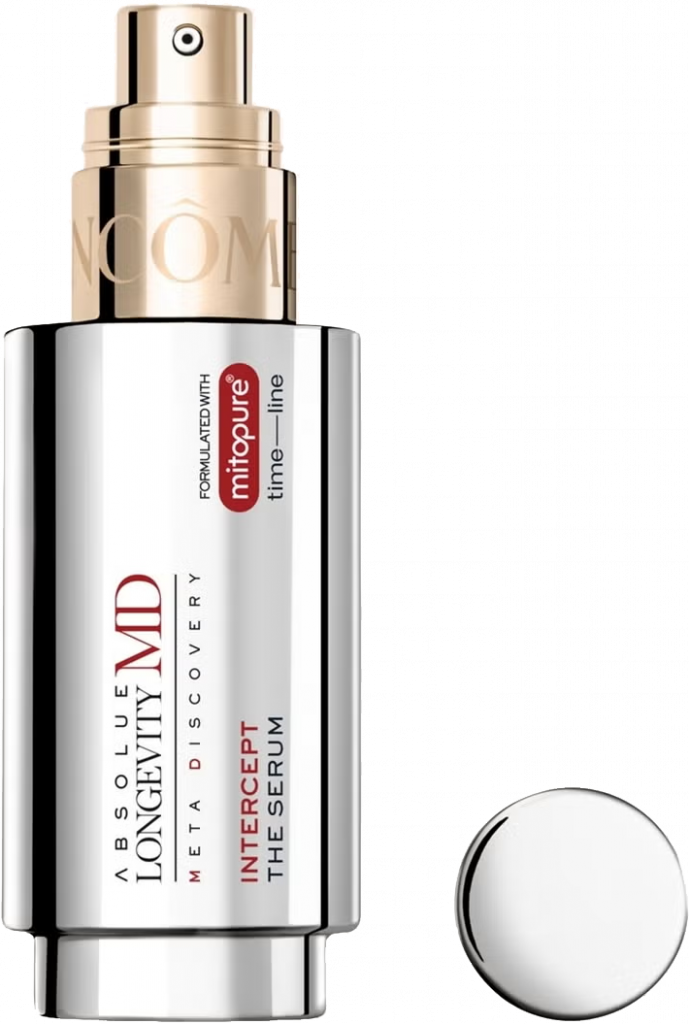
Lancôme positions the Intercept range for the stage when visible signs of ageing are beginning to appear.
What Lancôme reports
Lancôme’s product testing reports improvements including:
- Up to 52% greater skin elasticity
- Up to 42% increased radiance
- Up to 35% reduction in the appearance of crow’s-feet wrinkles
Lancôme also reports a 94-person clinical study examining six visible signs of skin ageing.
Key ingredients
Urolithin A + Lancôme Intercept Compound™.
UrolithinA.com view
Probably one of the most interesting products in the range for consumers investigating Urolithin A skincare because it combines the ingredient with a serum format and has finished-product clinical testing.
The results nevertheless apply to the whole formulation, not specifically to Urolithin A.
For established visible signs of ageing…
A premium face cream combining Urolithin A with Lancôme’s proprietary Reset Compound™.
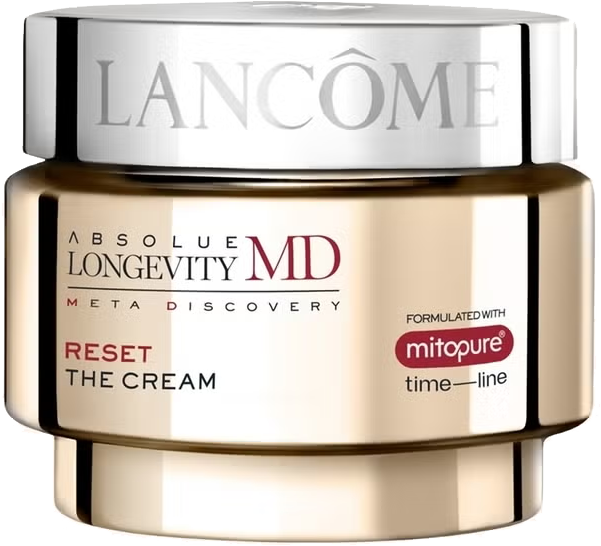
It sits at the most intensive end of Lancôme’s Anticipate → Intercept → Reset system and is marketed towards established visible signs of skin ageing.
What Lancôme reports
- Up to 55% improvement in skin rebound
- A reported improvement equivalent to up to four years in its measure of visible biological skin age
- Up to 31% recovery effect
The skin-rebound measurement came from instrumental testing involving 40 people. The “visible biological age” result comes from a clinical study of 94 people over two months.
Key ingredients
Urolithin A + Reset Compound™, including ingredients such as rhamnose, niacinamide, Rose Pro-Xylane™ and taurine.
UrolithinA.com view
Reset The Cream has some of the strongest manufacturer-reported headline results in the Longevity MD collection.
The phrase “visible biological skin age” should be interpreted carefully. It is Lancôme’s assessment based on changes in specified visible skin-ageing signs and should not be read as evidence that the product makes a person’s cells or body biologically four years younger.
A premium serum containing Urolithin A alongside Lancôme’s Reset Compound™.
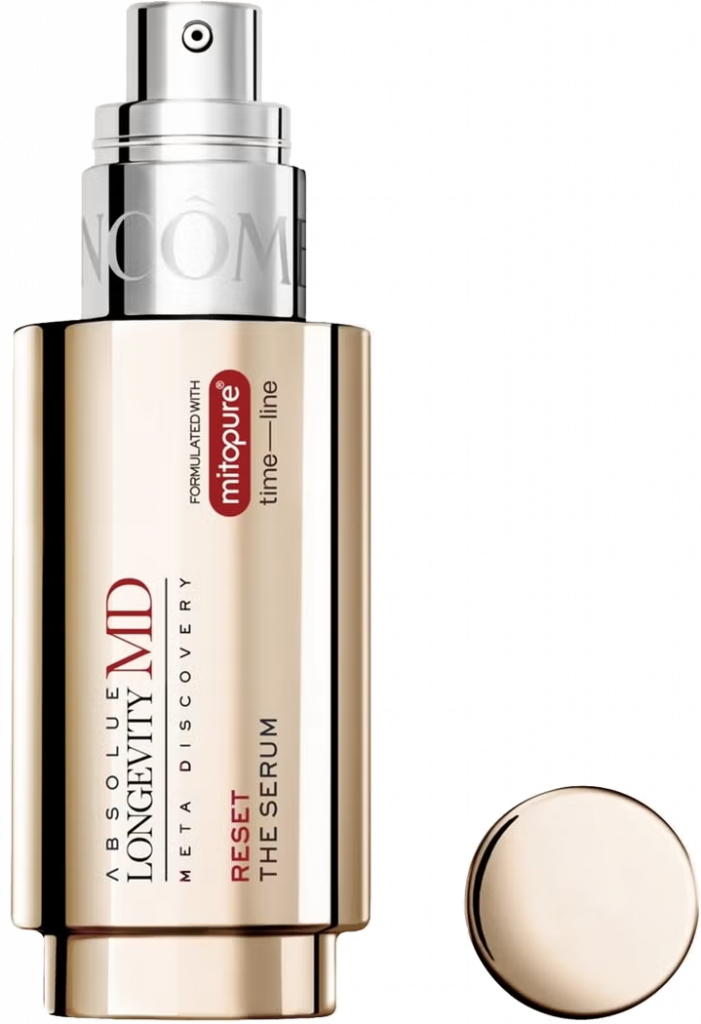
Lancôme positions Reset for more established visible signs of skin ageing and says the formulation has also been tested for its effect on surface-cell renewal.
What Lancôme reports
- Up to 41% increase in tightened-skin measurements
- Up to 22% increase in skin firmness
- Faster surface-cell renewal in instrumental testing
The firmness and tightening measurements were obtained from an instrumental test involving 40 people, while surface-cell renewal was assessed in 35 people after 22 days.
Key ingredients
Urolithin A + Reset Compound™, which Lancôme describes as including rhamnose, niacinamide, Rose Pro-Xylane™ and taurine.
UrolithinA.com view
One of the more scientifically interesting products in the range because Lancôme provides several instrumental measurements alongside its broader cosmetic claims.
However, these studies test Reset The Serum as a formulation and do not isolate the contribution made by Urolithin A.
Why this range is scientifically interesting
This is important because the finished Lancôme formulations — rather than Urolithin A alone — have been subjected to product-specific testing. Lancôme reports clinical and instrumental results for measures including the appearance of wrinkles, skin firmness, elasticity and surface cell renewal.
These are manufacturer claims about specific cosmetic formulations and should not be interpreted as proof that Urolithin A itself reverses ageing, or that oral and topical Urolithin A have equivalent effects.
Our assessment
The Lancôme range is a significant real-world application of Urolithin A in cosmetics and provides substantially more finished-product information than many ingredient-led skincare products.
However, consumers should distinguish between:
- evidence for Urolithin A as an ingredient;
- evidence for a particular finished formulation;
- cosmetic improvements in appearance;
- and broader claims about cellular or biological ageing.
Why the finished formulation matters
A topical ingredient must:
- remain stable in the product;
- be compatible with the other ingredients;
- reach the relevant layer of skin in a suitable form;
- be present at a tested concentration;
- remain safe under normal and reasonably foreseeable use;
- produce an effect in the finished product, not only in isolated cells.
A supplier’s study on one formulation cannot automatically support every cream or serum containing the ingredient.
How to assess a Urolithin A cosmetic
Ask:
1. Is Urolithin A listed in the ingredients?
2. Is the concentration disclosed?
3. Was the exact finished product tested?
4. Was the study randomised and controlled?
5. How many people completed it?
6. How long was it used?
7. Were photographs standardised and blinded?
8. Were results based on instruments, expert grading or self-report?
9. Did the control contain the same moisturising base?
10. Who funded and performed the study?
Reasonable cosmetic language
Depending on adequate evidence for the finished product, acceptable-style wording may focus on appearance, for example:
- “designed to support the appearance of healthy-looking skin”;
- “helps improve the appearance of fine lines”;
- “supports smoother-looking skin”;
- “helps keep skin in good condition.”
The manufacturer remains responsible for substantiating each claim.
Language to avoid
- “reverses cellular ageing”;
- “repairs UV-damaged DNA”;
- “treats sun damage”;
- “regenerates diseased skin”;
- “prevents skin cancer”;
- “activates immunity to heal the skin”;
- “clinically proven to make skin biologically younger.”
Such claims may be unsupported, misleading or medicinal rather than cosmetic.[18,19]
Urolithin A is not a substitute for sun protection
Preliminary research involving UV responses should never be presented as an alternative to a broad-spectrum sunscreen, shade, protective clothing and established sun-safety advice. A cosmetic without an authorised and correctly tested sun-protection claim should not be used as sunscreen.
Conclusion
Topical Urolithin A is a plausible but emerging cosmetic technology. Look for transparent concentrations, well-designed finished-product studies and realistic appearance-based claims. The evidence does not currently support describing it as a proven reversal of skin ageing.