
How Urolithin A Works
Urolithin A is studied primarily because of its relationship with mitophagy, a specialised form of cellular quality control. To understand that proposed mechanism, it helps to start with mitochondria.
Why are mitochondria important?
Mitochondria are structures inside most human cells. They help convert nutrients into adenosine triphosphate, or ATP, which cells use to power many activities. Mitochondria also contribute to signalling, metabolism and responses to cellular stress.
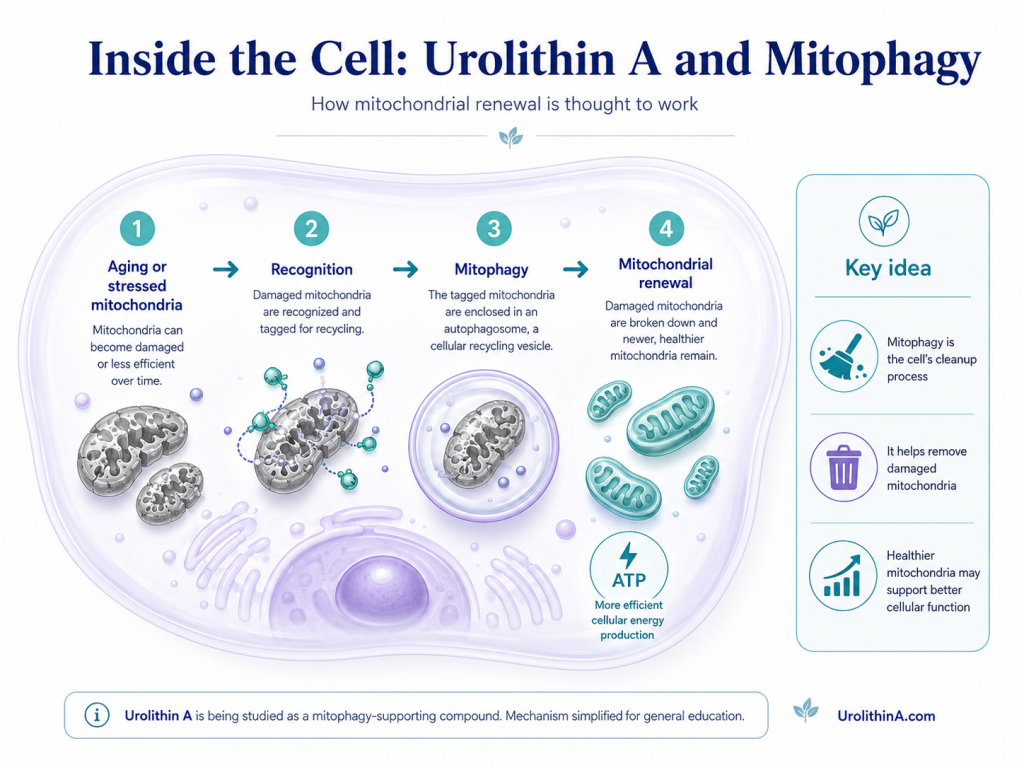
Like other cell components, mitochondria can become damaged. Cells use quality-control systems to identify, dismantle and recycle damaged mitochondria. The selective recycling of mitochondria is called mitophagy.
Preclinical research identified Urolithin A as a compound capable of activating mitophagy. Human studies have since reported changes in muscle gene expression, blood metabolites and mitophagy-related proteins after supplementation.[1,2,5] These biomarker changes support biological activity, but they do not prove that everyone will feel more energetic, become stronger or age more slowly.
What do mitochondria do?
Mitochondria are membrane-bound structures present in most human cells. They are widely known for helping produce ATP, the chemical energy used by cells, but they also participate in:
- metabolism of fats and other nutrients;
- calcium handling;
- cellular signalling;
- responses to oxidative and other stress;
- programmed cell death;
- immune-cell activity.
The phrase “powerhouse of the cell” is a useful introduction, but mitochondria are more than simple batteries.
Why do mitochondria need quality control?
Mitochondria contain proteins, lipids and their own small genome. They are exposed to continual metabolic activity and can lose efficiency or become damaged. Cells respond through an interconnected quality-control network that includes repair, changes in mitochondrial shape, production of new components and selective removal.
A failure in mitochondrial quality control is associated with ageing and many diseases. An association does not mean that one supplement can prevent those conditions.
What is mitophagy?
Mitophagy is the selective removal of mitochondria through the cell’s autophagy and lysosomal recycling systems.
A simplified sequence is:
1. The cell detects a mitochondrion that is damaged or no longer functioning appropriately.
2. Molecular signals mark it for removal.
3. A membrane structure encloses the selected mitochondrion.
4. The enclosed material is delivered to a lysosome, where components are broken down and recycled.
5. The cell maintains its mitochondrial network through repair, turnover and biogenesis.
Mitophagy is not a “detox” in the everyday marketing sense. It is a regulated biological process occurring inside cells.
A simplified illustration of mitochondrial recognition, enclosure and recycling. Actual mitophagy involves multiple interacting molecular pathways.
Where might Urolithin A act?
The foundational preclinical study reported that Urolithin A induced mitophagy in the nematode C. elegans and improved selected muscle-function measures in rodents.[1] Later laboratory work has investigated several signalling routes, and the precise pathway may vary by cell type and experimental context.
Human evidence is more indirect. Studies have reported:
- changes in mitochondrial gene expression in skeletal muscle after four weeks of supplementation;[2]
- changes in plasma acylcarnitines and other metabolites;[2,4,5]
- increased abundance of some mitophagy-related proteins in muscle;[5]
- changes in fatty-acid oxidation and mitochondrial features in immune cells.[7]
Together, these findings support the view that Urolithin A can be biologically active in humans. They do not prove that it “rebuilds mitochondria” throughout the body or that more mitophagy is always better.
Does Urolithin A create new mitochondria?
Mitophagy removes selected mitochondria, while mitochondrial biogenesis refers to the production of new mitochondrial components and expansion of the mitochondrial network. These processes interact, but they are not identical.
Marketing diagrams sometimes show damaged mitochondria being replaced immediately by new, perfect mitochondria. That is a simplification. The 2024 systematic review found changes in some mitochondrial genes, autophagy markers and fatty-acid oxidation, but did not find a consistent effect on maximal mitochondrial ATP production, mitochondrial biogenesis or dynamics across the included human studies.[6]
Does mitophagy mean more energy?
Not automatically. A change in mitochondrial quality or a biomarker may not translate into a noticeable change in energy, fatigue or physical performance.
In the JAMA Network Open trial, maximal ATP production in the hand muscle and six-minute walking distance did not improve significantly compared with placebo, even though secondary muscle-endurance outcomes and biomarkers favoured Urolithin A.[4]
This is why UrolithinA.com separates:
- mechanism: what happens in cells;
- biomarker: a measurable biological signal;
- functional outcome: strength, endurance or performance;
- clinical outcome: health, symptoms, disease or quality of life.
Evidence at one level cannot automatically establish the next.
Is mitophagy always beneficial?
Mitophagy is essential to normal cell biology, but biological systems require balance. Too little or poorly regulated mitophagy can be harmful; excessive or inappropriate removal of mitochondria could also be undesirable in some contexts. Studies of a compound in healthy volunteers cannot establish suitability for every medical condition.
Key takeaway
Urolithin A has a credible and experimentally supported connection with mitochondrial quality-control biology. The strongest wording supported for consumers is that it influences markers and pathways associated with mitophagy. Claims that it repairs all mitochondria, cures fatigue or reverses cellular ageing go beyond current evidence.[1-7]